

Table of Contents
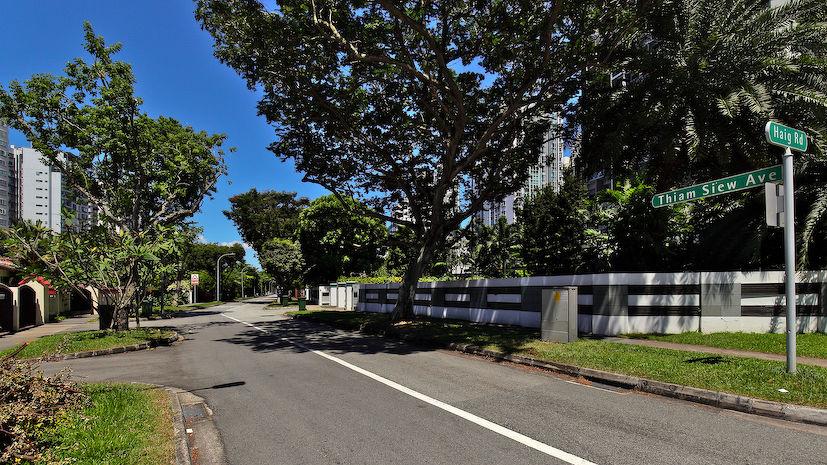
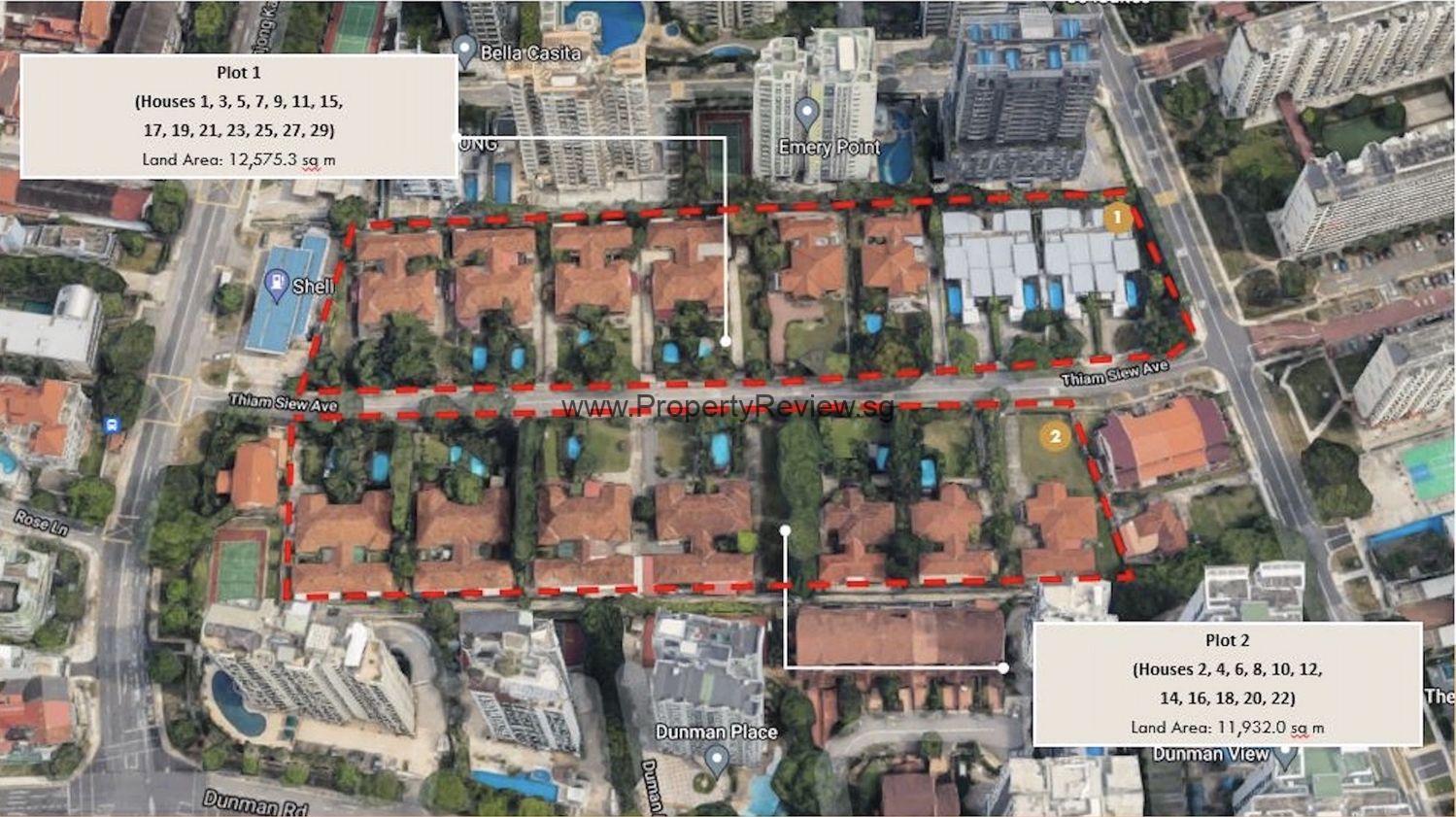 Thiam Siew Avenue, a small street with just 25 residences, is located between Tanjong Katong Road and Haig Road. Many of the homes are pre-war single-story semi-detached houses and bungalows with 9,000 to 10,000 square feet of land apiece.
They are the legacy of Wee Thiam Siew, a property mogul and hotelier who died in 1972. The properties are mostly controlled through Thiam Siew Avenue Investments and Wee Thiam Siew & Co, whose beneficiaries are his family members, many of whom are third generation. Wee was the previous owner of Rochor Road New 7th Storey Hotel, Hollywood Theatre and Lion City Hotel, as well as the chairman of Ban Leong & Co, a cigar, cigarette, and tobacco distributor.
The New 7th Storey Hotel (which really had nine storeys) was the highest edifice on Rochor Road when it was erected in 1953. The government bought the hotel in 2008 to build the Bugis MRT Interchange Station that was used for Downtown Line, which opened in December 2013.
The late Loke Wan Tho, a movie entrepreneur, erected the Hollywood Theatre at Tanjong Katong Road in 1957 and inaugurated it in 1958. Hong Kong icons like Fung Bo Bo and Siao Fong Fong made appearances there during its peak in the 1960s and 1970s. The theater shuttered in the 1990s and was briefly home to City Harvest Church, then a grocery center, and finally Sheng Siong supermarket.
The Lion City Hotel, located next to the Hollywood Theatre, first opened its doors in 1968. Members of the Wee family owned and ran it until December 2010, when they decided to put both the Lion City Hotel and the neighboring Hollywood Theatre up for tender. The Singapore-listed UOL Group announced in January 2011 that it has bought the Lion City Hotel and Hollywood Theatre for $311 million at the completion of the bidding process.
The property was transformed into a mixed-use complex by UOL, which included a four-story Kinex mall with a net lettable area of 202,191 sq ft and the Katong Regency, a 244-unit condominium covering three blocks of nine to ten stories. The freehold condominium, which opened in April 2012, sold out all of its apartments in less than a week for an average price of $1,608 psf. The property was finished in 2015, and apartments have sold for $1,797 psf on the resale market.
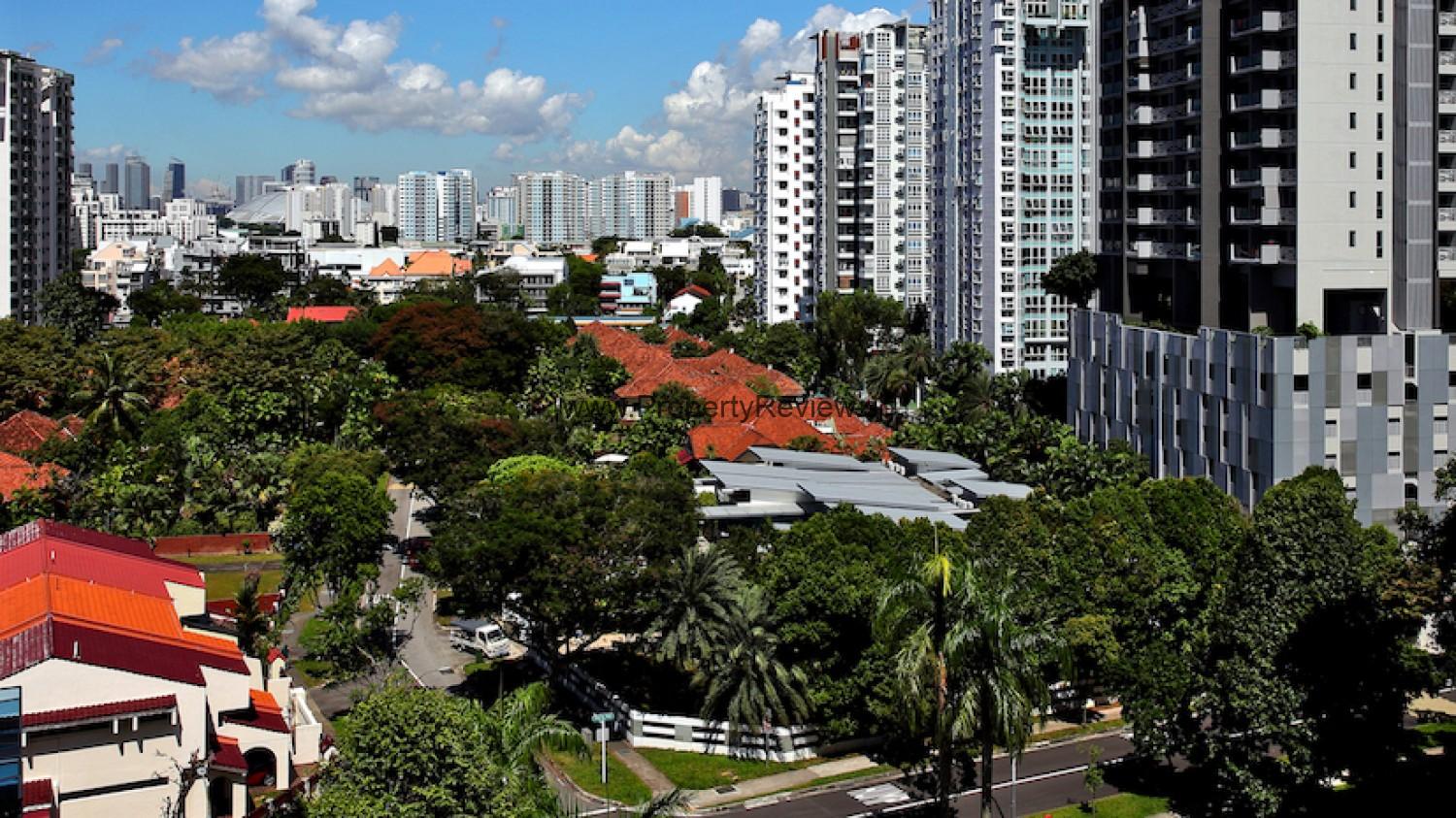
Wee used to live at 525 Dunman Road, which was right behind the Thiam Siew Avenue homes. It also situated on a sizable piece of land. The government had purchased a corner piece fronting Haig Road from the family, which was then put up for sale under the government land sales (GLS) program. Far East Organization bought the property in 1997 and leased it for 99 years. Dunman View, an 18-story, 148-unit high-rise condo completed in 2004, was built on the site.
The remaining land at Dunman Road was developed into a terraced housing project called Dunman Grove by one of the Wee family’s businesses, Wee Thiam Siew & Co. In 1990, the homes were finished, and a road was built for them.
A decade ago, several of the owners of Dunman Grove’s terraced homes came together and sold their properties to developer Hoi Hup Realty as a group. The 122-unit, 18-story Questa @ Dunman was built on the site. The freehold high-rise condo was finished in 2013 and has a combination of suites, one- and two-bedroom units ranging in size from 431 to 1,467 square feet.
Biggest Divestment for Wee Family
The Wee family has appointed Galven Tan of Savills Singapore, as the sole selling agent for the land lots along Thiam Siew Avenue. The Thiam Siew Avenue residences were constructed on property that used to be part of Wee’s private estate at 525 Dunman Road.
During the pre-war years, however, he opted to construct the homes there for rental revenue. In 1939, he called the route Thiam Siew Road, but in 1940, he renamed it Thiam Siew Avenue.
During the postwar years, the homes on Thiam Siew Avenue were subject to the Rent Control Act. The family kept the homes for lease when the Rent Control Act was repealed in 2001. “Many of the tenants have been there for a long time,” adds Tan of Savills.
The Wee family is preparing to sell all 22 land-plots with 25 residences along Thiam Siew Avenue after almost 80 years.
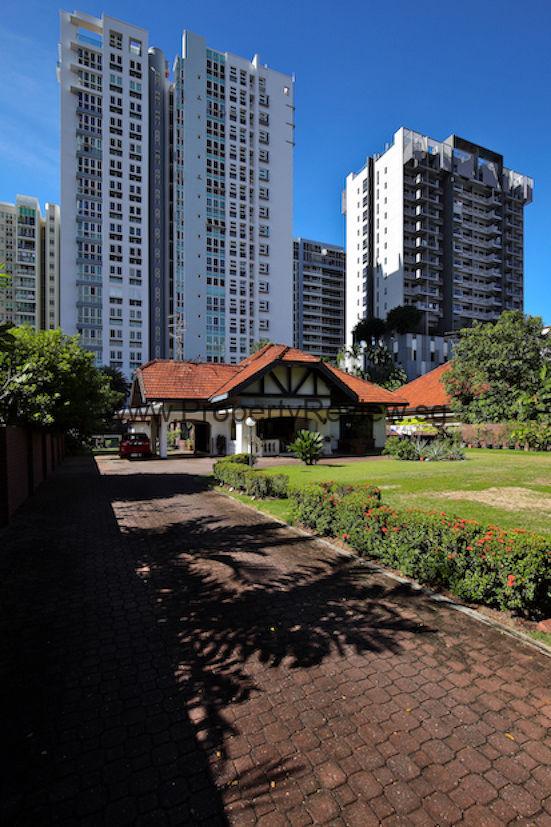
The semi-detached homes with odd house numbers at Nos. 1 to 17 were erected sometime in the early 1940s during the pre-war years. The two neighboring bungalows at Nos. 19 and 21 on the same row were also constructed before WWII. The four semi-detached homes at 23 to 29 were, on the other hand, erected in 2007. Plot 1 is made up of these residences, which lie on a freehold land area of 135,361 sq ft.
The even-numbered residences at Nos. 2 to 22 are located on the other side of Thiam Siew Avenue. The semi-detached homes at Nos. 2 to 16 are from the pre-war period, while the three bungalows at Nos. 18 to 22 are also from the pre-war era. Plot 2 is made up of these residences, which lie on a total freehold land size of 128,436 sq ft.
Potential for Redevelopment
According to Savills’ Tan, developers may acquire either Plot 1 or Plot 2, or both plots together. The developer may then buy Thiam Siew Avenue and cut it off since it only serves the residences on that street. Tan estimates that the total site size (without the road) is roughly 263,797 sq ft when the two plots are united. The overall site area would be roughly 300,000 sq ft if the road was included. The authorities must, however, approve the closure of the route.
Tan estimates that a new building at Thiam Siew Avenue may have a total gross floor area (GFA) of 738,632 sq ft based on the plot ratio of 2.8 for a residential development site under the URA Master Plan 2019.
Thiam Siew Residences is located in District 15 and is part of the excellent East Coast neighborhood. According to URA criteria, the average size of residential units in the proposed development must be at least 85 sq m (915 sq ft) since it is located in the Rest of Central Region or city edge. According to Tan, a developer might construct 414 condominium apartments on Plot 1 and 393 condominium units on Plot 2.
According to Tan, if the two lots were combined and the road was blocked off, a developer could create a new 800-unit condominium building with a variety of facilities.
Thiam Siew Avenue Investments owns all of the pre-war properties save those at Nos. 12, 19, and 22. Wee Thiam Siew & Co. owns the site that was constructed into the four semi-detached residences at Nos. 23 to 29 in 2007. The Wee family, on the other hand, is in charge of both organizations. Even the three residences at Nos. 12, 19 and 22 that are held in separate names are owned by members of the Wee family and will be sold.
On September 24, the land parcels will be put up for sale, with the tender concluding on November 18. The plots on Thiam Siew Avenue do not have a price tag. However, it is likely to be compared to other freehold plots in excellent District 15 that have been sold.
In October 2017, City Developments Ltd (CDL) and Hong Realty, a joint-venture partner, bought Amber Park en bloc for $906.7 million ($1,515 psf per plot ratio, or psf ppr). Meanwhile, in July 2018, GuocoLand paid $319.8 million for Casa Meyfort on Meyer Road. GuocoLand paid $1,580 psf ppr for the land, which included a development fee estimated at $57.8 million. (Use the en bloc calculator to find possible condominiums.)
‘Single-family business’
Thiam Siew Avenue is close to the Paya Lebar Central shopping district. The Paya Lebar Square, Paya Lebar Quarter (PLQ), and the Paya Lebar MRT Interchange Station. It’s also close to PLQ Mall and Kinex, two retail malls.
According to Savills’ Tan, good schools that are within 1km of Thiam Siew Avenue include Tanjong Katong Primary School and Kong Hwa School.
Despite the amount of new developments in the region, residential sales in the East have remained reasonably strong. Since its debut in May 2019, almost 80% of the 582-unit Amber Park has been sold. Since its introduction in 4Q2019, GuocoLand’s 200-unit Meyer Mansion has sold over 40% of its units. Although the median price at Meyer Mansion is $2,581 psf, at least eight homes sold for more than $3,000 psf, with values ranging from $3,009 to $3,182 psf.
In April 2017, half of the 429-unit Park Place Residences at PLQ were taken up at an average of $1,800 psf, and another 161 apartments were taken up at an average of $2,015 psf in April 2018. By the year 2019, the project has sold out completely. In August, a 17th-floor, 667-square-foot two-bedroom home sold for $1.495 million, bringing the project’s price per square foot to a new high of $2,240.
According to Savills’ Tan, such selling prices bode well for the land properties on Thiam Siew Avenue. “If a developer wants to create a major property with numerous facilities, they may look at either Plot 1 or Plot 2, or the two plots together,” he says.
According to Tan, the two plots at Thiam Siew Avenue are attractive since they are held by a single family, ensuring transaction certainty for the developer. “They are exempt from going through the strata title board.” He also points out that a freehold land of this size is becoming more scarce.
Thiam Siew

Thiam Siew Avenue, a small street with just 25 residences, is located between Tanjong Katong Road and Haig Road. Many of the homes are pre-war single-story semi-detached houses and bungalows with 9,000 to 10,000 square feet of land apiece.
Product SKU: Thiam Siew
Product Currency: SGD
Product Price: 10000000
Product In-Stock: InStock


