

Table of Contents
Recently, Pasir Ris 8, a newly-launched integrated development integrated with Pasir Ris MRT, has been in the headlines for its phenomenal sales, prompting a DBS analyst to link this to a symptom of an asset bubble. Now that the dust has cleared and the transactions have been made public, we’ve chosen to go further into the Pasir Ris 8 sales data, block by block and stack by stack, in order to discover the truth and possible lessons.
What is the significance of Pasir Ris 8?

This condo is an excellent case study for property searchers and professionals who want to learn more about pricing. The fact that all of the transactions took place within two days eliminates factors like time passing and therefore altering market expectations, which might skew the price analysis. The trend is also significant, which smooths out the outliers. Moreover, the developer, Allgreen, was able to alter their pricing several times over the course of the two days.
This meant that the caveated pricing correctly represented the underlying demand and supply of a well-functioning market or the real (or very near to actual) price that purchasers are prepared to pay. (A dysfunctional market, on the other hand, means that either seller have too much inventory that no one wants or buyers have unmet needs.) For example, during the early stages of the epidemic, most shops ran out of toilet paper because they were unable to change their price, despite the fact that customers were prepared to pay more. The final effect was that shops ran out of toilet paper, customers were enraged, and no one knows what the true price of toilet paper is.
Now that we’ve gone through each and every transaction, let’s see what our analysis of the transactions can tell us about the real estate market.
Hype Surrounding Pasir Ris 8
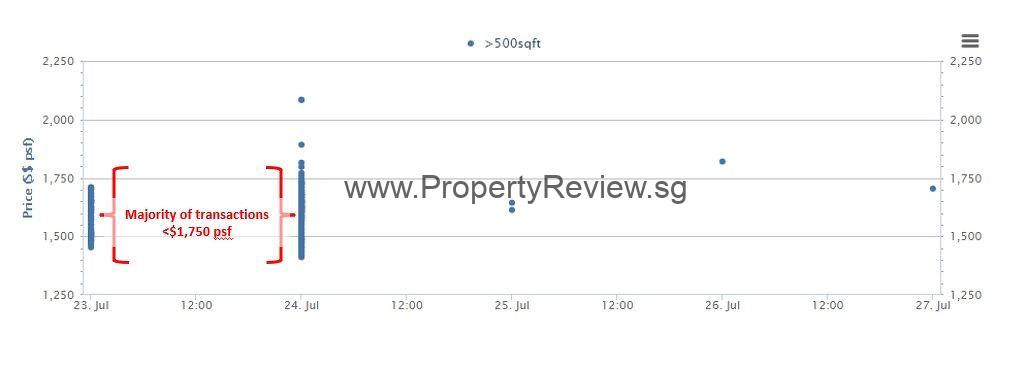
With the widely publicized fact that Allgreen had to modify their price six times over the opening weekend, Pasir Ris 8 generated a lot of buzz and excitement. Some prospective purchasers went to social media to express their dissatisfaction with the wait, only to be informed that the price had increased. However, the fact is that nearly all of the sales, 412 out of 417, were between $1,400 and $1,800 psf, which is a completely typical price range for any particular development. Only two deals surpassed $2,000 psf (we’ll come back to this later), and only three trades exceeded $1,800 psf. In other words, all the hullabaloo and fanfare stemmed from only 1.2 percent of the transactions, or five out of 417. So, the next time FOMO (fear of missing out) strikes, get the facts.
Stacks without Sales at Pasir Ris 8

Despite the high volume of purchases, there were a few stacks that went unsold. Stacks 2, 6, and 45 are the only ones that haven’t sold a single unit. Looking through the sitemap can help you understand why this is the case. Premium 3-bedroom + guest apartments are located in stacks 2 and 6, while regular 3-bedroom units are located in stack 45. Stacks 2 and 6 are the nearest to Pasir Ris Central, the major road. The noise produced by vehicles or the pedestrian bridge in stack 45 may deter potential purchasers.
There will be blocks/stacks at the least-preferred places in each development. However, you may want to avoid placing the most costly units in such stacks, or at the very least compensate for the inconvenient placements with other benefits such as a better view. The typical selling price for three-bedroom apartments in this complex ranges from $1.6 million to $1.9 million, which isn’t cheap. With this sort of money, purchasers may pick from a number of choices, such as stacking in the development’s better areas, or go somewhere else entirely.
Guard House versus Pool View Unit Pricing

How much extra would you pay to prevent seeing vehicles going in and out of the property from the guardhouse? We finally have the answer after going through the data. When looking out their balconies, purchasers are ready to spend an extra 2–3% to avoid seeing the guardhouse building. For example, the average prices of stacks 38 and 37 in block 14 are 2.8 percent more, or about $34,000 greater, than stack 33 in the same block. All of these stacks are the same size and kind (2-bedroom premium apartments). Similarly, the average values of stacks 22, 24, and 25 in block 12 are 2.3 percent more than stack 27 in the same block, or $58,000.
There are just two stacks of 2-bedroom apartments with a pool view in Pasir Ris 8. Stacks 60 and 62 are the ones in question. The average price of these stacks is $1,697 per square foot, or around $1.2 million, which is $68,000 higher than the cost of the 2-bedroom stacks without a pool view. This premium for pool-view apartments is probably a reasonable estimate since first-time purchasers searching for a 2-bedroom flat would have most likely selected these units before the price rises.

Where are the units transacted at $2,000 psf?
As I previously said, there were only two units that exceeded the $2,000 psf mark. Both of these apartments are on Block 20, floors 8 and 9, and are from stack 65, a 2-bedroom kind. We may never know the true reason for these purchasers’ willingness to pay such a high price, but we may make an informed estimate.
Blocks 18 through 20 are regarded “luxury” blocks, particularly for stacks that face outward. These stacks’ residents would have an excellent view of Pasir Ris Park and perhaps the Serangoon Harbour. However, a deeper look at the URA Master Plan reveals that the property immediately across the street from these blocks has been designated as a residential site since Master Plan 2008. When the new residential site is constructed, the view of the park and the sea will almost certainly be obstructed. I suppose one may take pleasure in it while it lasts!


